
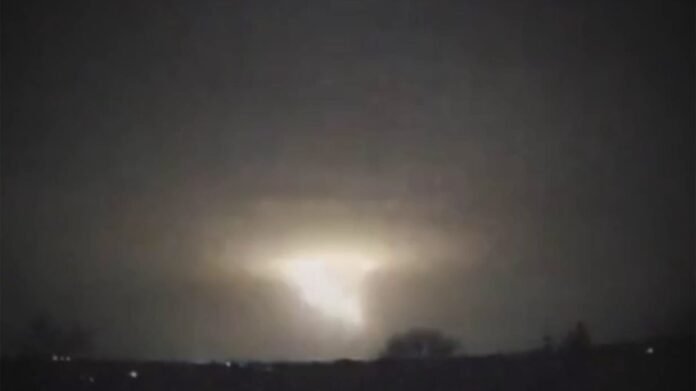

Vladimir Putin has launched a nuclear-capable missile named Oreshnik, reaching speeds of 8,000mph, in a series of devastating attacks on Ukraine. The assault targeted Europe’s largest underground gas storage facility on the outskirts of Lviv, located 40 miles away from NATO and EU territory in Poland. These strikes occurred alongside ongoing violence in Ukraine, including attacks on civilians in Kyiv and Volodymyr Zelensky’s birthplace, Kryvyi Rih.
The missile, launched from the Astrakhan region in Russia, exploded over Lviv in less than 15 minutes after launch, producing a distinct display of bright flashes illuminating the night sky in shades of pink and red. Speculation online suggested that Russia utilized a ballistic weapon similar to the Oreshnik due to its extraordinary speed. While the Russian defense ministry confirmed the use of the Oreshnik missile system, claiming it was in response to an alleged Ukrainian attempt to target Putin’s residence in Novgorod region, Western intelligence and Ukraine dispute this claim.
The Moscow defense ministry stated, “In response to the Kyiv regime’s terrorist attack on the residence of the President of the Russian Federation in the Novgorod region, the Russian Armed Forces launched a significant strike using long-range precision weapons, including the Oreshnik system, against critical targets in Ukraine.” This attack was described as achieving its objectives by targeting drone production facilities and energy infrastructure supporting Ukraine’s military-industrial complex.
The strike near the EU and NATO border was condemned by Ukraine’s foreign minister as a grave threat to European security. He emphasized that Russia’s attempt to justify the strike based on a non-existent attack on Putin’s residence was absurd. This incident marked the second time the Oreshnik missile system was used in an aggressive manner, the first being in Dnipro in 2024.
The Oreshnik system, known for its speed and power, is now stationed near Ukraine and NATO territory in Belarus. However, the recent strike originated from the Kapustin Yar missile test range in the Astrakhan region, possibly taking less than seven minutes to cover the 900-mile distance to its target. The impact of the strike on the Stryi gas storage facility’s infrastructure, crucial for Ukrainian supplies, remained unclear initially.
The attack on Lviv underscores Putin’s defiance of calls for peace, with continued assaults on various Ukrainian regions. Despite the missile’s nuclear capability, there is no indication that the Oreshnik strike was nuclear in nature. Putin’s deployment of the Oreshnik system is seen as a tactic to instill fear, signal escalation, and assert Russia’s extended reach. It is evident that Putin remains steadfast in his aggressive actions, disregarding international calls for de-escalation and peace settlement in the region.