
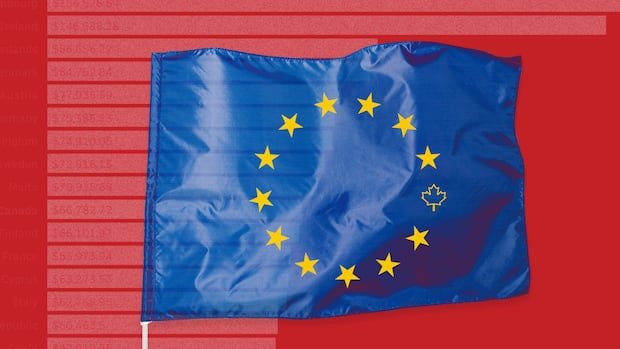

The European Union has expressed interest in Canada becoming the inaugural “associate member” of the 27-nation bloc, as global trade connections shift away from the United States.
European Commission President Ursula von der Leyen, in a state of the union address, emphasized the need for the EU and Canada to revamp their partnership beyond just a free-trade agreement.
Canadian Prime Minister Mark Carney welcomed the closer relationship in his own speech, highlighting Canada’s pursuit of “resilience” over open markets and sovereignty. He proposed enhanced integration in critical sectors such as critical minerals, artificial intelligence, defense, energy, research, and finance.
Carney stressed the importance of sovereignty in his address to the European Parliament, emphasizing the need for resilience to withstand challenges. Although “associate member” is not currently a recognized status, the EU’s regulations specify that only European nations can seek membership.
Regardless of the outcome, Canada is poised to strengthen trade links with Europe. Here are comparative charts illustrating Canada’s economy in relation to its potential European counterparts.
GDP per capita serves as a gauge of economic wealth distribution. While Canada has faced concerns about its GDP per capita compared to the US, data from the OECD places Canada midway among EU countries, surpassing France, Italy, and Spain. However, several EU nations fall below the OECD average, with countries like Australia and Iceland outperforming Canada.
On the inflation front, yearly data indicates that Canada has fared well compared to EU members, boasting a two percent inflation rate in 2025, lower than many counterparts. Amidst global challenges like high energy prices due to geopolitical tensions, Europe has witnessed rising interest rates in an attempt to control inflation.
When it comes to the total debt-to-GDP ratio, Canada’s position is less favorable. If Canada were an EU member, its 2025 total debt-to-GDP ratio would rank among the highest in the bloc, trailing behind France, Italy, and Greece. The International Monetary Fund has highlighted Canada’s debt levels, recommending a focus on reducing the ratio in fiscal planning.
As for trade relations, Canada’s trade with the EU has been substantial. Statistics Canada data shows imports of approximately $92 billion from the EU and exports of around $39 billion last year. Germany, a key economic player in the EU, features prominently in Canada’s trade interactions, importing machinery, vehicles, and pharmaceuticals while exporting energy products, ores, and precious metals.