
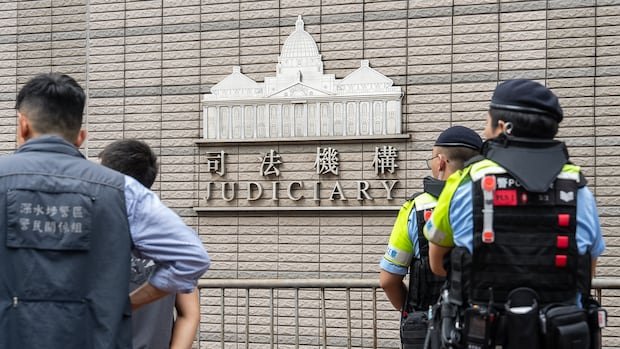

Two former organizers of the annual vigil in Hong Kong commemorating the 1989 Tiananmen Square crackdown have been found guilty in a national security case under a law imposed by China. Lee Cheuk-yan and Chow Hang-tung, previous leaders of the Hong Kong Alliance in Support of Patriotic Democratic Movements of China, were convicted of inciting subversion. They had denied the charges and could face up to 10 years in prison. The alliance was also convicted.
The judges stated that the alliance’s advocacy to “end one-party dictatorship” was not about urging the return to a multiparty system but aimed at undermining the Communist Party’s leadership. The judges emphasized that persisting with this call post the law’s implementation constituted a breach of the constitution, as the party’s leadership is a fundamental aspect of socialism with Chinese characteristics.
The verdict is part of a series of legal actions against Hong Kong’s pro-democracy movement, which has been significantly curtailed by local and Chinese authorities. The candlelight vigil organized by the alliance, previously a large-scale event drawing thousands annually, was prohibited in 2020 due to the pandemic, followed by the imposition of the security law to suppress the 2019 protests.
Lee and Chow acknowledged the public before leaving the courtroom and are awaiting sentencing. Critics view their trial as indicative of diminishing freedom of expression in the region. The judges are yet to provide detailed reasons for the conviction.
Legal expert Eric Lai highlighted that the charge of inciting subversion is commonly used in mainland China to target human rights activists. The trial focused on the alliance’s alleged call to overthrow the ruling party, with prosecutors arguing it was not about politics but inciting unlawful means to challenge the party’s leadership.
Chow emphasized that advocating to “end one-party rule” was about limiting unchecked power, not about removing the party entirely. The trial concluded swiftly after Albert Ho pleaded guilty at the onset. Lee’s wife expressed disappointment with the outcome, maintaining Lee’s innocence and considering an appeal.
Supporters of the convicted organizers cast doubt on the allegations, with some questioning the impact on the city’s legal framework. The crackdown at Tiananmen Square in 1989, where hundreds were killed, remains a dark chapter in China’s history, influencing its trajectory towards economic progress without political reforms.
The 2020 security law in Hong Kong, justified by Beijing for stability, led to the imprisonment of prominent activists like Jimmy Lai and the dissolution of civil society groups, including the alliance, reflecting the broader suppression of dissent in the region.