
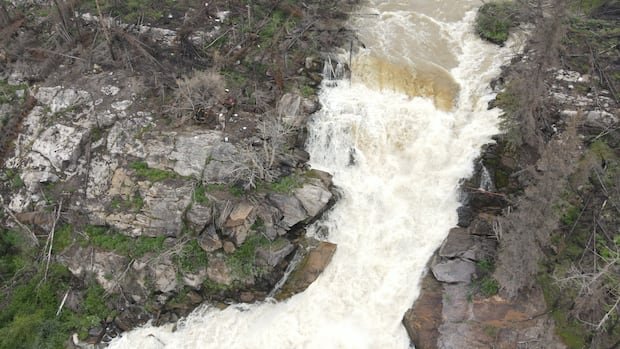

Two scientists have conducted a new assessment of a distant waterfall, indicating that the rarely-visited falls in the rugged boreal shield region of northern Manitoba may be the tallest in the province. Alexander Martin and Lukas Olson utilized digital photogrammetry to measure Kapakaytay Falls on the Odei River. Their initial findings suggest a height of 16 meters, slightly surpassing the 14-meter Kwasitchewan Falls near Thompson, which is widely believed to be Manitoba’s tallest waterfall.
Olson, a doctoral candidate at the University of British Columbia specializing in photogrammetry, expressed confidence in the measurement. The height of Kapakaytay Falls was previously recorded by the federal government decades ago, listed at 58 feet or approximately 17 meters on topographical maps, though this information was not widely disseminated. Martin, a Winnipeg resident and ecology PhD student at the University of Oxford, highlighted the importance of verifying whether Kapakaytay Falls indeed holds the title of Manitoba’s tallest waterfall due to the lack of established information.
Located on the Odei River, around 40 kilometers northwest of Thompson and 690 kilometers north of Winnipeg, Kapakaytay Falls is described as a highly inaccessible natural wonder. Martin and Olson embarked on their expedition in July, facing challenges such as navigating rapids, logjams, and treacherous terrains within wildfire-affected forests. The extensive journey covered 105 kilometers round trip, with local guides from the Thompson area assisting the researchers in making the expedition possible.
Upon reaching the waterfall after several days of strenuous paddling, Martin and Olson were captivated by its grandeur and the impressive flow of water cascading over the rocks. The expedition drew inspiration from a previous trip led by Winnipeg’s Garrett Fache in June 2019, who speculated on the height and appearance of the falls based on topographic maps and personal observations.
Utilizing over 1,000 two-dimensional drone images and laser measurements of the surrounding features, Martin and Olson employed digital photogrammetry techniques to reconstruct and measure Kapakaytay Falls. Their modeling work suggested a potential height adjustment compared to the federal government’s original measurement, indicating that Kapakaytay Falls might indeed surpass other notable waterfalls in Manitoba.
Despite the province’s assertion that Kwasitchewan Falls remains the tallest based on their data, Olson and Martin are dedicated to publishing their research findings and contributing to future studies of Kapakaytay Falls. The researchers emphasized the significance of documenting this remote and rarely-seen natural site, underscoring the value of continued exploration and documentation in areas that have not been extensively studied.